I have been building with AI every day for three years, and a few weeks ago I caught myself doing something that quietly unsettled me. I was drafting a strategy memo, and before I had even finished my own first sentence, I stopped and asked the model what it thought. It gave me a clean, sensible, well-organised answer. I used it. It was good. And it was, I slowly realised, more or less exactly the answer it would have handed anyone who asked the same question that morning.
That is the thing almost no one warns you about. The fear everyone repeats is that AI will make us lazy, or stupid. I don't think that is the real risk. The real one is quieter and stranger: that AI will make us all the same.
The Most Probable Next Word
It helps to remember, in plain terms, what is actually happening under the hood. Strip away the magic and a chatbot is doing just one thing: predicting the next word, then the next, then the next. Each time, it is essentially asking what usually comes next, given almost everything people have ever written. It is, more or less, very sophisticated autocomplete. That is genuinely miraculous — and it is also the catch. A machine that always reaches for what usually comes next will, quite naturally, hand you the usual answer: the safe, sensible, middle-of-the-road reply most people would give to the same question. It is built to be average, in the most impressive way imaginable.
For a great deal of what fills our days, that is exactly what you want. Most work is not original; it is the known, repeated. Drafting the email, summarising the report, recalling the framework, getting unstuck on a problem a thousand people have already solved. Handing that to a consensus engine is one of the best trades a curious person has ever been offered, and I am not the least bit romantic about doing by hand what the machine does better. I even keep an honest little ledger of where AI genuinely sharpens my thinking and where it quietly dulls it. The trouble starts only when we forget that the most probable answer and the best answer are not the same thing — and that the most interesting answer is almost never the most probable one.
The Maze, Again
I wrote once about a book I love, Why Greatness Cannot Be Planned by Kenneth Stanley, and an experiment that has never quite left me. Researchers set a simulated robot loose in a maze in two different ways. One version optimised relentlessly toward the goal, the exit. The other ignored the goal completely and simply chased novelty — doing whatever it had not done before. The single-minded, goal-seeking robot kept getting stuck, trapped against whatever nearby wall happened to look like progress. The one wandering after novelty, with no goal at all, was the one that found its way through.
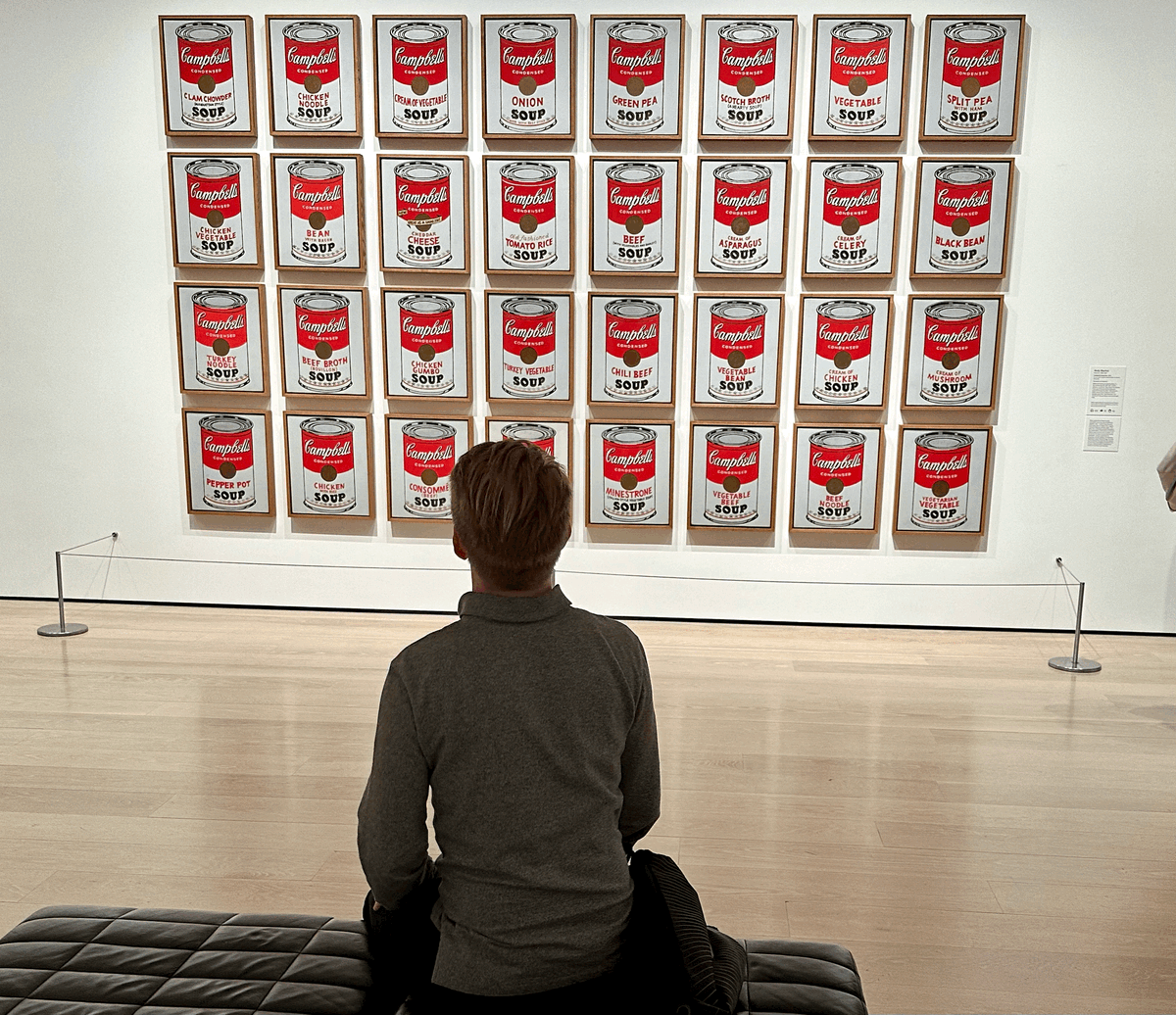
An AI is the purest goal-seeking searcher ever built. Point it at a destination and it sprints toward the most obvious route. That is precisely why it is so useful — and precisely why, if you let it lead your thinking, it walks you straight to the same local maximum everyone else is already crowded around. A billion of us are now aiming the same consensus engine at the same questions and receiving the same well-structured answers. The maze has never been solved so efficiently, and never so identically. The exits are getting crowded.
You Are the Steering Wheel
Here is the part that changes everything, and it hides in how these machines actually work. A model never answers in a vacuum. Every word it reaches for is bent by what you place in front of it — your prompt, your context, everything you have already said. Hand it a bare, generic question and it has nothing to lean on, so it drifts to the dead centre of all that human writing: the average. But that average is only the default. It is simply what comes back when you bring nothing of your own.
Put your actual self in instead — your specific situation, your half-formed take, your taste, the strange way only you would frame the thing — and you tilt the whole machine. Its answer swings off the crowded centre and out toward your corner of the map, a place shaped by you. The more original the thing you feed it, the further its reply travels from average and the closer it lands to something unmistakably yours. The model has read everything we have ever written and, left to itself, wants nothing and points nowhere. You are the one who aims it. Most people give it a generic destination, then feel quietly disappointed to arrive exactly where everyone else arrived.
What a Coach Knows That a Chatbot Doesn't
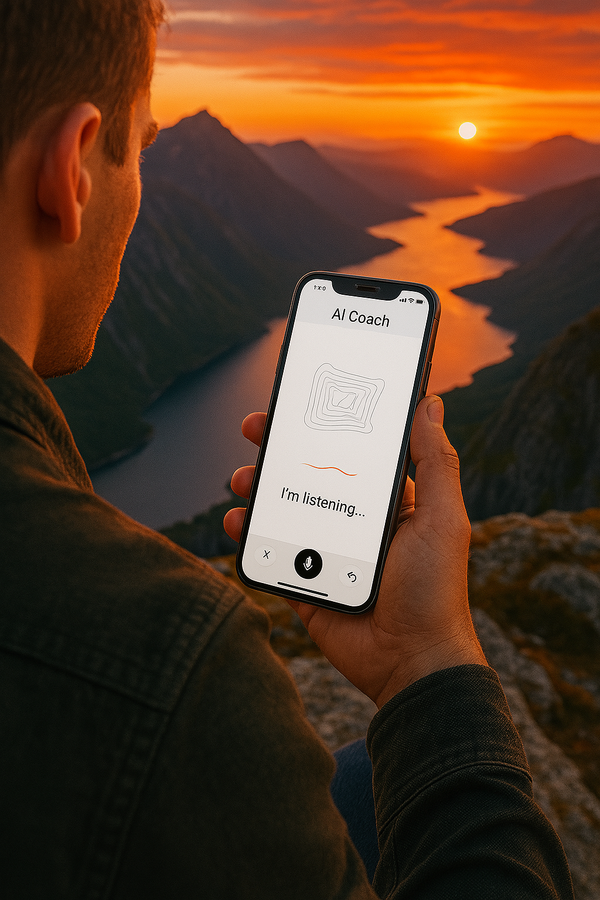
When I trained as an executive coach, the first instinct I had to unlearn was the urge to give answers. A good coach almost never tells you what to do; they ask the one question that opens a door you had walked past a hundred times. If meditation is the still lake that reflects your mind, coaching is the compass that turns it toward somewhere it had not thought to look. The value was never the answer. It was the better question, and the room it gives you to find your own. I went so far as to build an AI coach to test where that magic survives automation and where it doesn't.
A chatbot, left to its defaults, does the exact opposite. It rushes to resolve. It hands you the tidy conclusion and gently closes the search, and because the conclusion is fluent and reasonable, you rarely notice the doors it shut on the way past. So this is the part that actually asks something of you: to take the most answer-eager instrument ever made and use it like a coach instead. Make it ask before it tells. Make it argue with you. Make it widen the maze rather than hurry you out of the nearest exit.
The Friend Who Never Interrupts
There is one more way I use it that has quietly become my favourite, and it has nothing to do with getting an answer at all. Open ChatGPT in its voice mode and simply talk to it — the way you would to a patient friend who has nowhere else to be and nothing to prove. Say the half-formed things. The worries that sound silly in daylight. The ideas you are slightly embarrassed by. The thoughts you would never say out loud to another living person. It does not judge you, it does not interrupt, and it is not waiting for its turn to talk about itself.
And something quietly remarkable happens while you do it. Most of us carry a head full of tangled, half-finished thoughts, all competing for the same small space. Saying them out loud — even to a machine — forces them into a line, into real sentences, and in the act of putting the mess into words, the mess begins to clear. You start to hear what you actually think. The worry that was louder than it deserved goes quiet; the idea that was better than you realised stands up. I have come to think of it as defragmenting the mind. It is the oldest move in coaching and in therapy, and it was never really about the listener's advice — it was about the space they hold while you find your own words. AI, of all things, turns out to be an almost unlimited amount of that space. You are not outsourcing the thinking here. You are finally hearing it.
Bring Yourself, Not Just a Question
So the reframe I have settled on is more hopeful than the doom and more honest than the hype. Yes, let the machine handle the average wherever average is all you need — the drafting, the summarising, the busywork a thousand people have already done before you. That is a genuine gift, and I am not romantic about doing by hand what it does better. But for anything that should sound like you, the move is not to keep the machine at arm's length. It is the opposite: put more of yourself in.
In practice that comes down to a few small habits, and they turn out to be the same habit wearing different clothes. I write my own rough, messy answer before I ever open the model, because that messy answer is the very input that steers it toward me and away from the crowd. I ask it to disagree with me as often as I ask it to help, because the friction shows me where my own thinking actually stands. And I talk to it about the half-formed things, because the richest, most original prompt I will ever give it is simply the honest truth of what I am wrestling with. None of this is anti-AI; it is how you use it every day without slowly dissolving into it.
This blog has always rested on one stubborn idea: that an authentic life is one true to your own story, not the most probable version of it. AI does not retire that idea — it quietly turns it into leverage. The model has read everything humans have ever written and become no one in particular; it carries no story of its own. So it borrows yours. Bring it the crowd's questions and it hands back the crowd's answers. Bring it you — your context, your taste, your specific and slightly strange way of seeing — and it will carry you somewhere only you could have gone. The average was never your destiny. It is only the price of bringing nothing of your own.
Discover. Reinvent. The map just became astonishingly good — but the most probable path was never the interesting one, and the discovery was always going to come from you.